

Preparing for Your First Macular Degeneration Visit in Texarkana

Being referred to a retina specialist for macular degeneration can bring a lot of questions. You may be wondering what testing will be performed, whether treatment will be needed, and what changes in your vision mean. Preparing a few details before your first appointment can make the visit more productive and help you better understand your retinal health.
At Four States Retina, we provide specialized retinal care in Texarkana, TX, including evaluation and treatment of age-related macular degeneration. Your first visit gives us an opportunity to review your history, examine the retina, perform appropriate imaging, and discuss what the findings mean for your vision.
Bring Your Medical and Eye Health Information
Your overall health can provide important context when evaluating macular degeneration. Bring an updated medication list, including prescription medications, over-the-counter products, vitamins, and supplements.
If you have previous eye records, retinal images, or reports from another ophthalmologist or optometrist, those can also be useful. Bring your current glasses as well, even if they no longer seem to provide the same clarity they once did.
Do not stop or change medications or supplements before your appointment unless the healthcare professional managing them has advised you to do so.
Write Down Changes You Have Noticed
Macular degeneration affects central vision, which is important for reading, recognizing faces, driving, and seeing fine details. Tell your retina specialist about any changes you have noticed, even if they seem subtle.
Information worth bringing to your Texarkana appointment includes:
When you first noticed a change in your vision
Whether one eye or both eyes seem affected
Blurry or missing areas in your central vision
Straight lines that appear wavy or distorted
Difficulty reading or recognizing faces
Changes in color or contrast
New dark, blurry, or blank areas in your vision
Any previous retinal treatments, injections, or procedures
If you have been using an Amsler grid or another vision-monitoring tool at home, mention any recent changes you have noticed.
What Happens During a Retina Evaluation?
A macular degeneration visit involves more than checking your glasses prescription. Your retina specialist needs a detailed look at the macula, which is the central portion of the retina responsible for fine-detail vision.
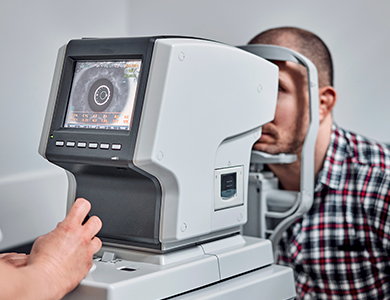
Your appointment may include visual acuity testing and a dilated retinal examination. Dilating drops temporarily enlarge the pupils so the specialist can examine the retina more thoroughly.
Optical coherence tomography, or OCT, may also be used. OCT creates detailed cross-sectional images of the retina and can help identify changes in the macula, including fluid or structural abnormalities. Other retinal imaging may be recommended depending on your individual findings.
Because dilation can temporarily make your vision blurry and more sensitive to light, consider bringing sunglasses and planning ahead for transportation if you do not feel comfortable driving afterward.
Ask Whether You Have Dry or Wet AMD
Age-related macular degeneration, or AMD, can occur in different forms. Dry AMD is more common and often progresses gradually. Wet AMD occurs when abnormal blood vessels develop beneath the retina and leak fluid or blood, potentially causing more rapid central vision changes.
Ask your retina specialist which type you have, how advanced the condition appears, and whether one or both eyes are affected.
Treatment recommendations depend on these findings. Some patients require monitoring, while others may need treatment such as intravitreal injections. Your retina specialist can explain what is appropriate for your specific situation and how often follow-up visits are needed.
Know Which Vision Changes Need Prompt Attention
Do not wait for a scheduled follow-up if you develop sudden new distortion, a noticeable dark area in your central vision, or a rapid decrease in vision. New flashes, a sudden increase in floaters, or a curtain-like shadow across your vision can indicate a different retinal problem and also require prompt evaluation.
If you have been diagnosed with macular degeneration or need a specialized retinal evaluation in Texarkana, schedule an appointment with Four States Retina at 5501 Medical Park Way, Texarkana, TX 75503 by calling (903) 204-7642.
Quick Links

All Eye
Care Services
Keep
In Touch
Contact Us Let’s keep in touch!

Office Hours
- Monday 8:00am - 4:30pm
- Tuesday 8:00am - 4:30pm
- Wednesday 8:00am - 4:30pm
- Thursday 8:00am - 4:30pm
- Friday 8:00am - 4:30pm
- Saturday Closed
- Sunday Closed
Closed for lunch from 12 pm-1 pm
© 2026 Four States Retina | All rights Reserved | Accessibility Statement | Privacy Policy | Sitemap
Powered by:
